













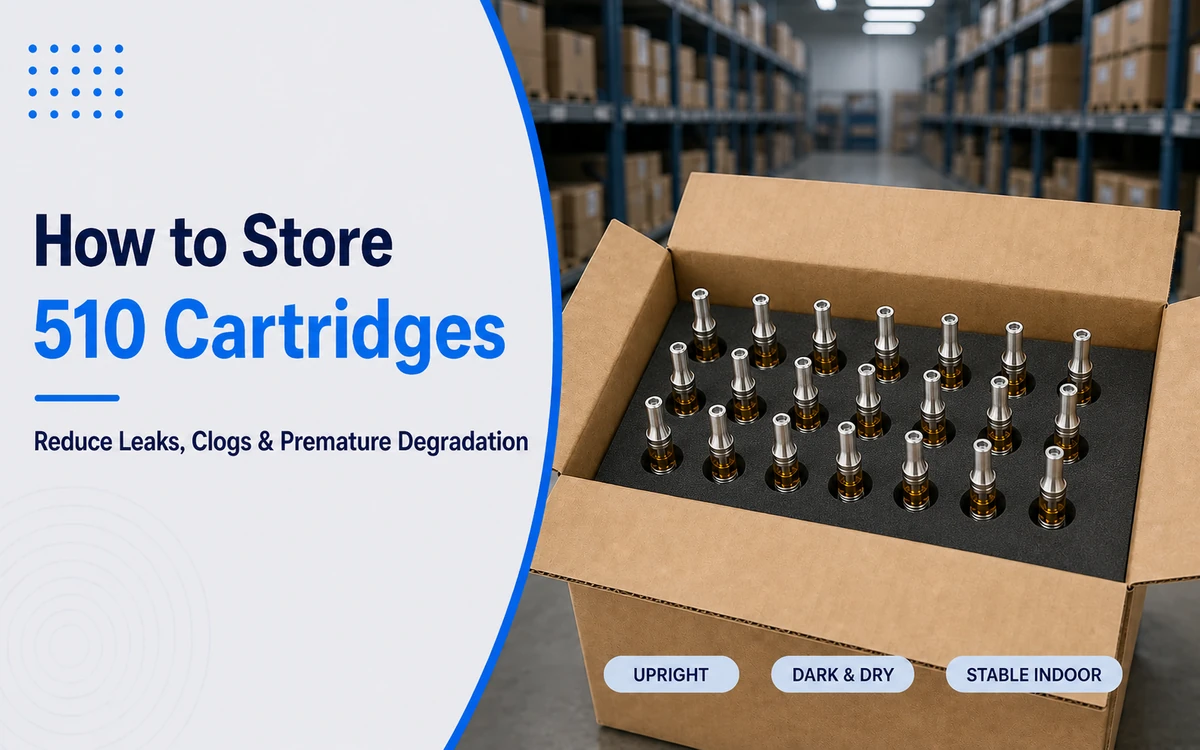
How to Store 510 Cartridges to Reduce Leaks, Clogs, and Premature Degradation

Poor storage can expose a 510 cartridge to unnecessary heat, light, dust, or moisture and may allow oil to migrate toward the mouthpiece or airflow path. This guide explains how to store 510 cartridges for daily use, longer storage, and B2B inventory, with practical steps for reducing preventable leaks, clogs, and premature product changes. Because oil formulations and hardware designs differ, upright storage in a clean, dry, dark place is a practical default—not a leak-proof guarantee or a substitute for the manufacturer’s instructions. You will also learn when to separate a cartridge from its battery, why refrigeration is not a universal recommendation, and which warning signs call for inspection, troubleshooting, or replacement.
Quick Answer
Here is how to store 510 cartridges correctly: keep each one upright, mouthpiece up, in a clean, dry, dark place with a stable indoor temperature. Keep cartridges away from direct sunlight, heaters, hot vehicles, freezing conditions, and repeated temperature swings. Use original caps or packaging. For longer storage, detach a removable cartridge from the battery if the device instructions permit.
Key Takeaways
- Upright, mouthpiece-up storage is a practical default for many 510 cartridges, but it cannot compensate for a damaged seal, overfilling, or mismatched oil and hardware.
- No single storage temperature or shelf life applies to every 510 cartridge; use the filled-product label and hardware supplier’s instructions when available.
- Direct sunlight, hot vehicles, freezing conditions, and repeated hot-to-cold cycles create more risk than a stable indoor environment.
- Filled cartridges, empty hardware samples, and bulk inventory require different controls, especially for packaging, lot tracking, and inspection.
- Proper storage may reduce preventable leaks and clogs, but it is not a repair method for an already damaged or malfunctioning cartridge.
How to Store 510 Cartridges: A Seven-Step Checklist
A practical general method is to keep each cartridge upright, protected, clean, and within the product-specific conditions provided by its manufacturer or filler. Use this checklist unless the product instructions specify another method.
- Read the product instructions first. Check the package, filled-product label, and hardware documentation for storage, handling, and use-by information.
- Inspect the cartridge before storing it. Look for cracks, a loose mouthpiece, exterior liquid, damaged packaging, or contamination around the connector.
- Place it upright with the mouthpiece facing up. Use a fitted case, tray, or stand so the cartridge cannot tip over easily.
- Choose a clean, dry, dark location. Keep the cartridge away from windows, heaters, damp areas, dust, and direct sunlight.
- Avoid temperature extremes and rapid changes. Do not leave the cartridge in a hot vehicle, next to a heat source, or in freezing conditions.
- Protect the mouthpiece and connector. Keep original caps, inserts, or packaging in place when the product is not in use. Do not let loose metal objects or debris contact the connector.
- Recheck before use. Confirm that the cartridge is intact, dry on the outside, correctly connected, and still within the filled product’s labeled period of use.
Why Should a 510 Cartridge Be Stored Upright?
Storing a 510 cartridge upright with the mouthpiece up is a sensible default because it keeps the oil reservoir in its intended orientation and may reduce prolonged oil contact with the mouthpiece or central airflow path. Upright storage lowers risk; it does not guarantee that a cartridge will never leak or clog.
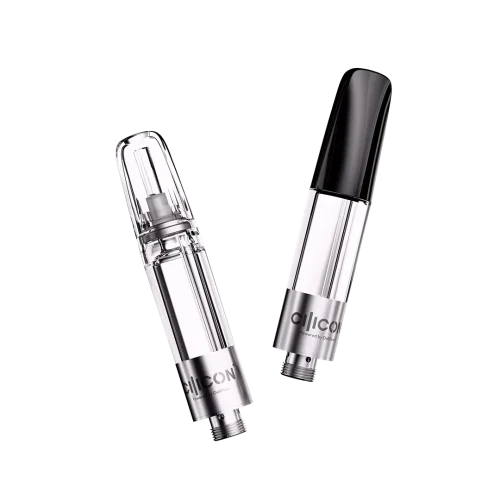
The term “510” describes a widely used threaded connection. It does not mean that every cartridge has the same reservoir, seals, intake openings, airflow path, or oil compatibility. A center-post cartridge and a postless cartridge may move air and oil differently even though both connect to a 510 thread battery. For a deeper explanation of the components, see how 510 carts work.
If a cartridge was briefly left on its side, that does not automatically mean it is ruined. Set it upright, inspect the mouthpiece and connector for escaped oil, and follow the manufacturer’s instructions. Do not connect a visibly leaking cartridge to a battery.
What Temperature Is Best for Storing 510 Cartridges?
There is no verified universal storage temperature for every 510 cartridge. A stable, moderate indoor environment within the filled-product and hardware supplier’s documented range is a safer default than heat, freezing, or repeated temperature swings.
| Storage Condition | Why It Matters | Practical Response |
|---|---|---|
| Direct sunlight or a hot vehicle | Heat may make some oils flow more readily, while sunlight and heat can affect the filled product and expose an attached battery to extreme temperatures. | Move the cartridge to a shaded, stable indoor location. Never use a hot vehicle as routine storage. |
| Freezing or refrigeration | Cold changes oil viscosity. Repeated cold-to-warm transitions may also create moisture concerns around the cartridge or connection. | Refrigeration is usually unnecessary unless the filled-product manufacturer specifically requires it. |
| Frequent hot-to-cold changes | Changes in viscosity, internal pressure, and condensation may contribute to inconsistent flow or contamination. | Minimize repeated transitions and allow a sealed product to stabilize before use. |
| Dusty or damp areas | Dust, moisture, or debris can contaminate the mouthpiece, connector, or packaging. | Use a clean, dry case or the original sealed package. |
| Stable indoor conditions | A consistent environment avoids the most common storage extremes. | Keep the cartridge upright, protected from light, and within documented product limits. |
FDA battery-care guidance advises users to follow the device manufacturer’s recommendations and protect vape batteries from extreme temperatures, including direct sunlight, hot vehicles, and freezing conditions. That guidance supports careful device storage, but it does not establish one temperature range for every cartridge.
Can You Store a 510 Cartridge in the Refrigerator?
Refrigeration is generally unnecessary unless the filled-product manufacturer explicitly recommends it. Low temperatures can thicken oil, and moving a cold cartridge into a warm or humid environment may introduce condensation concerns.
If a product has manufacturer-approved refrigerated storage, keep it sealed as directed and let it return to the specified use condition before connecting it to a battery. Do not warm a cold cartridge with an open flame, hair dryer, heater, or other uncontrolled heat source.
How Storage Can Affect Leaks, Clogs, and Oil Degradation
Storage is one factor among several. Cartridge design, seal integrity, fill level, oil viscosity, intake geometry, airflow, battery output, handling, and temperature can all affect performance.
| Issue | Storage-Related Mechanism | What Storage Can and Cannot Do |
| Leakage | Sideways placement, heat-related viscosity changes, or temperature and pressure changes may allow oil to migrate toward seals or airflow channels in some designs. | Upright, stable storage may reduce migration. It cannot repair a cracked tank, loose mouthpiece, damaged seal, or overfilled cartridge. |
| Clogging | Oil or condensate can collect in an airflow path; cold conditions may thicken the oil, while repeated heating and cooling may produce inconsistent movement. | Stable, upright storage may reduce buildup. It does not safely clear an existing obstruction. |
| Premature degradation | Light, air exposure, temperature, and time can affect cannabinoid stability or composition in some tested cannabis materials and preparations. | Dark, protected storage may reduce exposure, but the research does not establish a shelf life for a filled 510 cartridge. Follow the filler’s labeling and validation. |
Published research has found that light, air, time, and storage temperature affected the stability or composition of the cannabis preparations and plant materials tested. The Fairbairn study and a later four-year storage study were not tests of filled 510 cartridges, so they should not be used to promise a particular cartridge shelf life or leak-prevention result. For more detail on oil aging and expiration intent, see Cilicon’s guide to preserving oil longevity.
How to Store Filled Cartridges, Daily-Use Carts, and Empty Hardware
The correct storage process depends on whether the cartridge is in daily use, filled and unopened, or still empty. Treating all three states as identical can introduce contamination, inventory, or compatibility problems.
A Cartridge in Daily Use
Keep a daily-use cartridge upright in a stable stand or case, away from direct sun and extreme temperatures. If it remains attached to a battery, turn off or lock the device when that function is available and follow the battery manufacturer’s instructions.
For longer periods, detaching a removable cartridge is a conservative way to reduce accidental activation and protect the connection, provided the device instructions allow it. Battery separation is not a universal requirement for every 510 system.
A Filled Spare or Unopened Cartridge
Keep a filled spare in its original sealed package and in the orientation specified by the filler. Retain the batch, fill, and use-by information. Do not assume that “unopened” means the oil or hardware will remain unchanged indefinitely.
The 510 connection does not determine product shelf life. Formulation, packaging, filling conditions, hardware compatibility, and the filler’s validated dating all matter.
Empty Cartridge Hardware and B2B Samples
Keep empty hardware in its original protective trays, bags, caps, or cartons until it is needed. Protect the mouthpiece, intake area, seals, and electrical connection from dust, moisture, oils, solvents, and unnecessary handling. Do not remove factory protection early simply to display or reorganize the units.
Cilicon supplies empty 510 thread cartridge hardware for brands, distributors, and OEM/ODM projects. Filled-cartridge instructions in this article are general educational guidance; the brand or filler remains responsible for the formulation, filling process, final packaging, labeling, and market compliance.
Daily Storage vs. Longer Storage
Daily storage prioritizes convenient upright placement and preventing accidental activation. Longer storage requires stronger packaging, identification, and inspection controls.
| Situation | Cartridge Placement | Battery Handling | Packaging and Records | Check Before Use |
| Between daily uses | Upright in a stable case or stand | Turn off or lock if supported | Keep the mouthpiece protected | Exterior leaks, connector cleanliness, physical damage |
| Filled spare | Upright or in the filler-specified orientation | Store separately unless instructions say otherwise | Original sealed package, batch and use-by information | Package integrity, leakage, unusual product changes |
| Empty sample | Factory orientation in a clean tray | Not applicable | Original caps, bag, lot, model, and receipt date | Dust, moisture, deformation, damaged seals or contacts |
| Warehouse or transport inventory | Validated carton orientation with movement controlled | Batteries handled under their own documented requirements | Lot traceability, environmental limits, excursion records | Sample inspection and release decision after transit |
A B2B Storage and Transport Checklist
Brands and distributors should convert general storage advice into a product-specific SOP for the exact oil, cartridge, closure, packaging, and shipment route. A generic “510-compatible” label is not a substitute for filled-product validation.
- Keep empty hardware, filled goods, returns, and nonconforming units in clearly separated areas.
- Preserve the supplier’s original caps, trays, and cartons until the appropriate production step.
- Record the cartridge model, hardware lot, formulation lot, fill date, packaging date, and responsible production line.
- Define storage and transport conditions from supplier documentation and filled-product validation rather than copying a universal internet temperature.
- Validate package orientation, leakage resistance, vibration exposure, and relevant temperature cycles for the intended distribution route.
- Record environmental excursions and establish who can release, inspect, rework, or quarantine affected stock.
- Inspect a representative sample after transport for cracks, seal movement, oil migration, connector contamination, and package damage before market release.
- Use FIFO or FEFO only within a documented dating and inventory-control system; do not invent a shelf life when none has been validated.
Hardware design can reduce risk, but no product is leak-proof under every formulation and condition. Brands evaluating hardware can review Cilicon’s leak-protection solutions and discuss testing requirements for the intended oil and distribution conditions.
What Should You Check Before Using a Stored Cartridge?
Inspect a stored cartridge before connecting or activating it. Do not use it if the tank, mouthpiece, connection, package, or attached battery shows signs of damage that the product instructions do not permit.
Check for:
- Cracks, deformation, a loose mouthpiece, or a damaged seal
- Liquid on the exterior, inside the package, around the airflow opening, or on the connector
- Dust, moisture, corrosion, or foreign material on accessible surfaces
- Product separation, color, odor, or texture changes outside the filler’s stated normal range
- Missing lot, use-by, or identification information for inventory that requires traceability
- Excessive heat, swelling, impact damage, or other abnormalities in an attached battery
A darker color by itself does not prove that a filled cartridge is expired or unsafe. Evaluate changes against the filler’s instructions and other warning signs. If a cartridge is actively leaking, cracked, repeatedly clogging, or contaminating the battery connection, isolate it and consult the product manufacturer or Cilicon’s guide to common 510 cart issues. Do not use a flame, sharp tool, uncontrolled heat, or electrical bypass to restore it.
Common 510 Cartridge Storage Mistakes
The most common mistakes expose cartridges to gravity, heat, contamination, or accidental activation. Correcting the storage habit may prevent future problems, but it will not reverse existing hardware damage.
| Mistake | Why It Is a Problem | Better Practice |
| Leaving a cartridge on its side or upside down for long periods | Oil may remain against the mouthpiece, seals, or airflow path in some designs. | Store it upright in a fitted stand or case. |
| Keeping it in a car or sunny window | Vehicles and windows can expose the cartridge and battery to heat and direct light. | Use a shaded, stable indoor location. |
| Refrigerating or freezing every cartridge by default | Cold can change viscosity, and repeated warming may create moisture concerns. | Refrigerate only when the manufacturer explicitly requires it. |
| Carrying it loose with keys or debris | The cartridge can tip, suffer impact, collect debris, or damage the connector. | Use a protective case and keep battery contacts away from metal objects. |
| Leaving a cartridge on an active battery during longer storage | The device may activate accidentally, and leakage can contaminate the connection. | Detach it when the instructions permit; otherwise switch off or lock the device. |
| Removing factory protection from empty hardware too early | Dust, moisture, handling, or mixed lots can compromise production readiness. | Retain original caps, trays, bags, and lot identification until use. |
| Applying flame, high heat, or sharp tools after storage | Uncontrolled repair attempts can damage the cartridge, battery, seals, or contents. | Stop use and follow verified manufacturer troubleshooting or replace the unit. |
Frequently Asked Questions
Do 510 cartridges need to be stored upright?
Upright, mouthpiece-up storage is a practical default for most removable 510 cartridges. It can reduce the time oil spends against the mouthpiece or airflow path, which may lower the chance of migration in some designs. It is not a guarantee against leaks or clogs. Follow a different orientation if the cartridge or filled-product manufacturer explicitly specifies one.
Can I leave a 510 cartridge on its side?
Briefly leaving a cartridge on its side does not automatically ruin it. Return the cartridge to an upright position and inspect the mouthpiece, tank, and connector before use. If oil has escaped, the tank is cracked, or the battery connection is contaminated, do not activate the device until the manufacturer’s guidance has been followed.
Can 510 cartridges be stored in the refrigerator?
Refrigeration is usually unnecessary unless the filled-product manufacturer requires it. Cold changes oil viscosity, and moving a cold cartridge into a warm environment may create condensation concerns. If refrigerated storage is approved, keep the cartridge sealed as directed and allow it to reach the specified use condition naturally. Do not use uncontrolled heat to warm it.
Should I remove a 510 cartridge from the battery for storage?
For longer storage, removing a detachable cartridge is a conservative way to reduce accidental activation and keep leaked oil away from the battery connection. It is not mandatory for every 510 system. Follow the battery and cartridge instructions; if the cartridge remains attached, turn off or lock the device when that feature is available.
Do 510 cartridges expire?
The 510 thread itself does not set an expiration date. A filled cartridge may have a use-by period based on its formulation, filling, packaging, and validation, while empty hardware has supplier-specific storage requirements. There is no universal shelf life for all cartridges. See how long carts last for the separate lifespan topic.
Does proper storage prevent every leak or clog?
No. Proper storage can reduce preventable oil migration, contamination, and temperature-related stress, but it cannot correct a cracked tank, damaged seal, incompatible formulation, overfill, blocked airway, or unsuitable battery output. Repeated problems with the same oil-hardware combination require product-specific troubleshooting and validation rather than a different storage position alone.
How long can a 510 cartridge be stored?
There is no responsible universal answer. Use the filled-product label, manufacturer instructions, lot records, and validated storage conditions. For B2B inventory, define acceptance dates and environmental limits for the exact formulation, hardware, closure, and package. Do not adopt a generic online shelf-life number for all 510 cartridges.
What should I do if a stored cartridge is leaking?
Stop using it and keep it away from the battery and other inventory. Place the cartridge upright in a suitable nonabsorbent secondary container, inspect for cracks or a loose closure, and follow the manufacturer’s handling instructions. Do not activate, heat, puncture, or disassemble a leaking cartridge. Businesses should quarantine the affected lot pending documented review.
Conclusion
The best general answer to how to store 510 cartridges is to keep them upright with the mouthpiece up, protected from light, dust, moisture, heat, freezing, and repeated temperature swings. Retain original packaging, follow the product instructions, and separate a removable cartridge from its battery during longer storage when the device guidance permits.
Storage can reduce avoidable leaks, clogs, and premature degradation, but it cannot replace compatible hardware, sound filling and sealing, or product-specific validation. Brands sourcing empty 510 hardware can explore Cilicon’s cartridge options and contact Cilicon to discuss samples, packaging, OEM/ODM requirements, and testing for a specific oil-hardware combination.

Written by:
Ethan Parker
Hello, I’m Ethan, a content marketing specialist at CILICON, a top-tier cannabis vape manufacturer. My goal extends beyond merely promoting products; it is more importantly about helping people understand and learn about cannabis and vaping, providing them with relevant knowledge and information. Having graduated from University of North Carolina, I cultivated a strong passion and interest in nicotine, cannabinoids, and vape products. At CILICON, I integrate this knowledge and enthusiasm into content creation, sharing interesting and valuable insights.
